SWC News Center
Southwestern College Welcomes U.S. Consul General Lance Hegerle to Advance Binational Education and Workforce Development
By: Dr. Joel Pilco - October 17, 2026
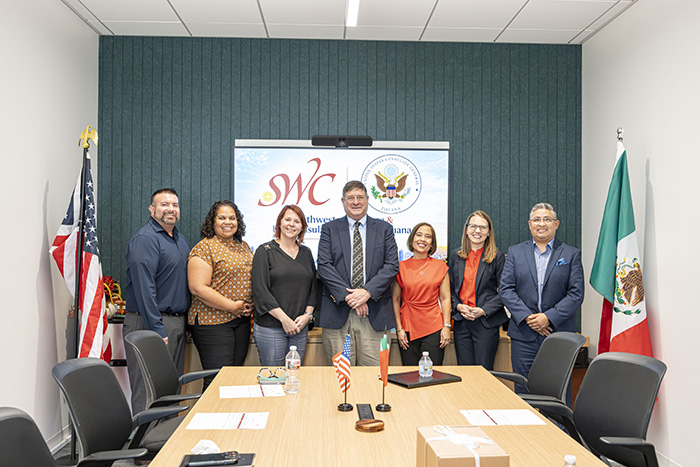
CHULA VISTA, Calif. — Southwestern College welcomed U.S. Consul General Lance Hegerle to campus on October 9 for a strategic visit focused on strengthening binational education, workforce development, and cross-border partnerships that support the economic vitality of the CaliBaja region.
The visit highlighted Southwestern College's leadership in creating educational opportunities that prepare students to thrive in a globally connected economy while addressing the workforce needs of employers throughout Southern California and Baja California.
A key focus of the discussions was the implementation of Assembly Bill 91 (AB 91) and the Coordinated Access Program (CAP), two initiatives that have expanded educational access for students who reside in Baja California and pursue higher education opportunities in the United States.
AB 91 allows eligible students who live within 45 miles of the California-Mexico border to receive an exemption from nonresident tuition at California community colleges, creating more affordable pathways to certificates, degrees, workforce training, and university transfer opportunities.
Southwestern College has also been at the forefront of implementing the Coordinated Access Program (CAP), a U.S. Customs and Border Protection initiative developed in collaboration with higher education institutions in the San Diego region. CAP provides qualifying students who commute daily from Mexico with access to designated expedited pedestrian crossing lanes at the San Ysidro and Otay Mesa Ports of Entry. By reducing border wait times, the program helps students spend more time in classrooms, laboratories, internships, and other educational activities that support their academic and career goals.
As one of the first community colleges in the region to participate in CAP, Southwestern College has helped expand access to higher education for binational students whose daily commute across the international border can present significant challenges. Together, AB 91 and CAP serve as innovative tools that remove barriers to education while helping develop the skilled workforce needed to support the region's growing economy.
The discussions also highlighted Southwestern College's partnerships with Universidad Autónoma de Baja California (UABC), CETYS Universidad, and the Secretaría de Educación Pública de Baja California. These collaborations have strengthened educational pathways between Baja California and Southern California, expanded college access and awareness, and fostered opportunities for academic and workforce development across the border.
Through these partnerships, students gain greater access to information about educational opportunities, transfer pathways, workforce training programs, and resources that support their long-term educational and professional success. The collaborative efforts also help align educational preparation with the needs of regional industries, creating a stronger talent pipeline for employers throughout the CaliBaja region.
As one of the most integrated binational economies in the world, CaliBaja depends on a workforce that can navigate international markets, diverse cultures, and rapidly evolving industries. Southwestern College's binational education initiatives are helping prepare students with the skills, experiences, and cross-cultural competencies needed to contribute to the region's continued growth and competitiveness.
The visit reinforced the importance of collaboration among educational institutions, government agencies, and community partners in expanding opportunity and supporting economic prosperity on both sides of the border. Discussions underscored a shared commitment to strengthening educational access, developing workforce talent, and advancing initiatives that position the CaliBaja region as a model for binational cooperation and innovation.
Through programs such as AB 91 and CAP, and through its partnerships with higher education institutions and educational leaders in Baja California, Southwestern College continues to demonstrate how binational collaboration can expand opportunity for students while building the workforce that will drive the future of the region.