SWC News Center
From Building A Buggy to Building A Future
By Javier Jorquera Estero - July 23, 2026
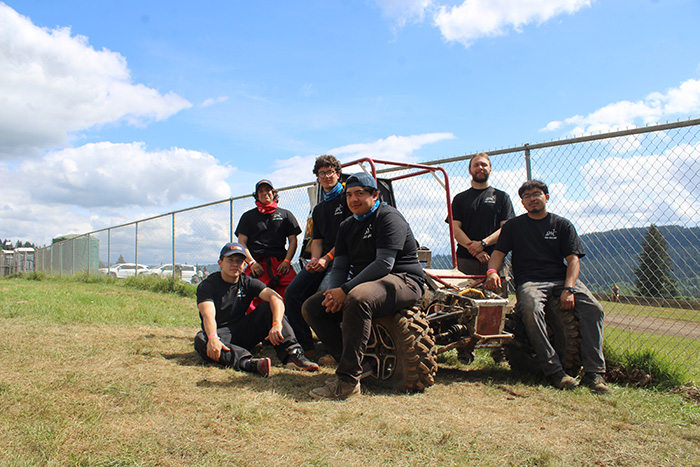
While walking to calculus class in the fall of 2025, I noticed a poster for the Southwestern College (SWC) Baja Society of Automotive Engineers (SAE) Club. While I was not familiar with Baja racing, I could tell it was related to engineering and motorsports, two things I have been passionate about since I was a child. The club stayed on my mind for months. I assumed as a freshman mechanical engineering student, I still did not have the technical and practical skills you would need to build an off-road race vehicle.
But, in January 2026, I decided to give it a go. When I arrived at Paco's garage, where he generously allows the team to work, I got my first look at the Baja buggy. SWC Baja Club members Santiago and Adrian were working on the electrical and mechanical systems. I explained I was a freshman and didn't have the technical skills of a mechanical engineer yet. They did not care at all, in fact, they wanted to help teach me. They told me to return the following Thursday and I have been coming back ever since.
By my second meeting, I was beginning to understand the work more. I met more club members, including Emilio, Troy, and Omar, and quickly realized how committed everyone was to the project. They spent most nights working until 3 a.m. or later, determined to get the Baja buggy ready for competition. Their dedication inspired me. We were all working toward the same goal, and every challenge we tackled together made us better engineers.
As the weeks went on, I learned how to use a grinder, cut and shape metal, operate a torque wrench, change oil, understand the fundamentals of welding, select the right materials, and much more. Working on the buggy felt more like hanging out with friends. I couldn’t believe how fast I was picking up skills that would actually matter for my engineering career. Every day after classes, I looked forward to heading to Paco's garage, where the team had become like family, where we’d spending the evenings working late into the night learning and building,
Next, I helped fine tune the suspension geometry and alignment, fabricate body panels, prototype engine components, replace differentials, and prepare and paint parts. Every component had to meet the Society of Automotive Engineers' official competition rules and technical specifications, adding to the layer of difficulty. However, it was a huge push in my learning curve.
Months passed and the buggy was finally complete and race day was within reach. Before loading up, the team carefully inspected every component to ensure the vehicle met competition regulations. Once everything was ready, the buggy, tools, and equipment were packed for the journey.
The competition would take place in Oregon, and with transportation assistance from UC San Diego, the team was able to bring the buggy and everything needed for the event. We were finally on our way to four days of competition, ready to put our hard work to the test.
Race day finally arrived. We met at the airport before 6 a.m., flew to Portland, Oregon, then drove straight to the Washougal MX track. As soon as we arrived, I realized just how big the competition was. Universities from across the country had professional pit setups complete with specialized tools, race-ready buggies, sponsor banners, trucks, and trailers. Compared with many of the other teams, we were a smaller community college with far fewer resources, but we were determined to prove we belonged.
After unloading our equipment, we immediately got to work. One of the first hurdles was the mandatory engine inspection. Because every team competes with the same engine, officials carefully verify that each vehicle complies with regulations. We arrived at the track around 10 a.m. and spent the next 10 hours preparing, inspecting, and making final adjustments.
The second day centered on the competition's most crucial test: technical inspection. Passing it was the key to competing in the official events, and the stakes were especially high because the SWC Baja team had fallen short the previous year. The inspection was exhaustive. Officials examined every aspect of the vehicle, from the safety harnesses, chassis dimensions, and electrical wiring to the emergency exit time, lighting systems, and overall compliance. There was no room for error.
The team spent the entire day making final preparations. Troy fabricated new metal components while reinforcing and welding the chassis. Santiago and Dr. K focused on the electrical system, developing an odometer that provided the driver with real-time metrics. The rest of us tightened hardware, checked measurements, and carefully reviewed the rulebook one last time. When everything was finally ready, we rolled the buggy into the inspection tent. Months of hard work had led to that moment, and all we could do was wait and hope we had done enough.
After our first inspection, the officials handed us a list of issues we were permitted to correct on the spot. I sprinted back to our pit to grab wrenches and replacement parts. We worked quickly, but when we returned, we still fell short of passing.
With less than 90 minutes remaining before technical inspection closed at 4:30 p.m., we had one final opportunity. The biggest obstacle was our brake light. Racing regulations required a specific model, and ours did not meet the standard. Emilio and I took off, running from pit to pit asking other universities if they had a spare. Thankfully, one team came through. We installed the new brake light, and returned for our second inspection. This time, the officials found no remaining issues.
We had passed! For SWC Baja Racing, it was a historic achievement. For the first time in the program's history, the team cleared technical inspection, earning the opportunity to compete in every event.
The team moved on to the next challenge: the business presentation. Santiago, Omar, and Adrian presented our project to judges, highlighting the work through photos, our budget, and the innovative and modified parts components we developed. Just like the buggy itself, the presentation was evaluated.
The final hurdle was the brake test. The buggy had to accelerate to top speed on a straightaway before braking hard enough to lock all four wheels, demonstrating it could safely stop under demanding conditions. We passed on our second attempt.
On the third day, we began competing in the dynamic events. The hill climb was a challenge. After a difficult first attempt, our all-wheel-drive system helped us secure a solid result on our second run, placing 32nd out of 63 teams.
The rock crawl was tough for every competitor. All teams shared concerns that the track path was not clearly marked. We finished 44th out of 57 teams. And in the acceleration event, we placed 54th out of 63.
At the end of the day, all teams walked the endurance race track, and we immediately understood the challenge ahead. The track was brutal, with massive jumps, deep dips, and a large mud pit. It was clear that many vehicles would struggle to make it through the full four hours. Teams knew that a suspension failure, electrical issue, or driver mistake could end their race at any moment. However, Dr. K gave us important advice: do not focus on being the fastest or the flashiest team. Instead, focus on being the steadiest.
The moment we had been preparing for had finally arrived. All the buggies lined up on the starting grid and then they were off. Our team spread out around the course, taking positions at different checkpoints to support our driver, Omar. Unfortunately, it did not take long for help to be needed. The call came over the radio: the buggy had broken down.
When we reached the vehicle, we discovered that the left control arm had snapped, and both front tires had developed cracks. Emilio immediately asked if other teams had spare tires available. At the same time, Troy and I began repairing the broken control arm. While cleaning layers of mud from the buggy, I found another crack, this time on the right control arm that needed to be repaired.
We installed smaller front tires that we borrowed from the University of Oklahoma and sent Omar back onto the track. The buggy managed to complete another lap before the same issue returned: more cracks in the control arms. We welded the damage again, this time reinforcing the control arms with additional metal. Troy took over driving duties. Although he did not complete a full lap before the problem returned, he managed to continue for two additional laps with the buggy partially damaged before officials eventually pulled him from the course.
We were out of the race, and our buggy was broken but the experience captured what Baja SAE is all about. The competition teaches engineering under pressure, adapting when things fail, and working together when the outcome is uncertain.
But in our first-ever competition, SWC Baja Racing accomplished something we were incredibly proud of: we outperformed many established university teams with larger programs and more resources. That achievement would not have been possible without the support of our sponsors, U.S. Bank and SDG&E.
We are already looking ahead and returning to competition even stronger next year.
I also want to mention the incredible dedication of Dr. Dimitry Kalantarov. He organized our journey to Oregon, provided access to the tools and workspace we needed, gave us the freedom to try innovative ideas and apply what we were learning. Most importantly, he believed in us and taught us things about engineering that will stay with us for the rest of our lives.