SWC News Center
Part Asian, Fully Me: Navigating My Mixed Asian American Identity at Southwestern College
By Troy Andrew Bash and Tristan James Kately - May 8, 2026
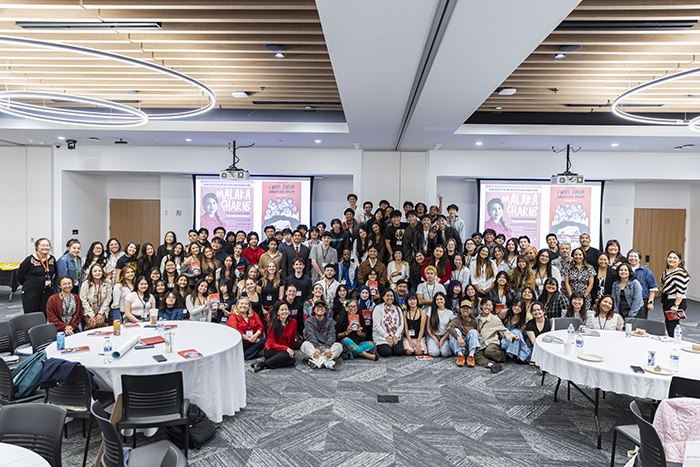
On May 1, 2026, Southwestern College (SWC) hosted the first San Diego Region 10 Asian American, Native Hawaiian, and Pacific Islander (AANHPI) Student Research Summit with students from City of College of San Diego, Mesa College, and Miramar College. Our keynote speaker, Malaka Gharib, gave us insight on the struggles of someone who is mixed-race and mixed-culture living in America. As a Filipina and Egyptian American person her story showed the complex idea of identity in a way that felt familiar to me as a mixed Filipino and White Student.
Malaka expressed difficulty having to constantly code-switch between the three cultures of her life; Filipino, Egyptian, and American culture. She would adjust how she spoke, acted, and even saw herself depending on her environment. That idea stayed with me because it reflects back to me with my own experiences. Growing up, I did not always feel connected to my Filipino identity. I attended a Christian elementary and middle school where I was the only Asian student. Surrounded by whiteness, I became comfortable in it. I was so disconnected from my Filipino side that I did not even realize I was Filipino until second grade.
At home, my culture told a different side of the story. My mom is fully Filipino, and my dad is half Polish and half Filipino, yet he still speaks Tagalog fluently. Even with his cultural presence, I guess I didn’t fully understand what it meant to carry both identities. Being part white and part Filipino did not feel like something I could easily explain to others, it often felt like something I had to figure out on my own.
Everything started to change in high school. For the first time, I was surrounded by a large Filipino community. More than half of my peers shared a background I had once felt distant from. I remember taking a Filipino class, at Olympian High School, where I immediately felt a sense of belonging. The environment was welcoming, and for the first time, I did not feel like I had to question whether I was “Filipino enough.” That experience changed how I saw myself.
Dance became another important part of that journey. During my second year of high school, I joined the Olympian All Male as well as Filipino Dance Club in my school and started doing different dances like tinikling and sayaw sa bangko and hip-hop. These different styles helped me realize that my identity did not have to be separated into parts. Through dance, I could express both my Filipino heritage and the American culture I grew up in.
As a mixed student being African American as well as Filipino I connected heavily to the ideas that were stated by Malaka Gharib the guest speaker at SWC. Her story as a mixed Filipino and Egyptian identifying person was something that was intriguing as well as something that felt very familiar and personal to me.
Malaka spoke a lot about the inbetween feeling that she had in her experiences being a first generation American born to two immigrants who came to America with two completely different cultures. Malaka touched on this topic a lot throughout her life in California she had to traverse her multi culture identity and fit into groups of only one culture and at that being predominantly asian. Showing her balance of different cultures as well as the expectations pushed upon her.
Growing up as a Black and Filipino boy Malaka’s experience deeply resonated with me. It was a constant battle between figuring myself out and what I was as well as navigating throughout school to where I had belonged. There was a feeling of having to constantly explain certain parts of myself that just came with my identity. As well as other students having shared experiences that I just was not able to relate to furthering this gap. This feeling of code switching was prevalent in my relationships with others as I had learned to have to act a certain way around predominantly Asian groups and groups that were predominantly African American as well.
Despite the code switching it was always a struggle to have to fit in as it was this feeling of “too white for Black spaces and too Black for white spaces.” That made it difficult to fully connect with either side despite and making it feel like I did have to leave a side and that it was a two way street. This also impacted my identity as to be out of touch because of this feeling of needing to pick one or the other.